Families comparing ABA providers often start with a practical question: where will therapy happen? Some children receive services at home, while others attend a center designed for individual teaching and group activities. The most appropriate setting depends on the learner's clinical needs, treatment goals, where those skills are needed, and the family's circumstances.
What happens during in-home ABA therapy?
In-home sessions take place where many daily skills are used. A clinician might work on requesting help during play, following a morning routine, getting dressed, sitting at the table, or moving between activities. The exact goals come from the child's assessment and treatment plan.
The home also gives the clinical team a clear view of the family's routines. They can see the space, materials, and schedule the family already uses. Recommendations can then fit the household more closely.
Parents and other caregivers may have more opportunities to observe sessions at home. They can practise an agreed strategy with coaching from the clinician and ask questions when a difficult routine occurs. This involvement matters most when it feels manageable. A treatment plan should account for work schedules, siblings, privacy, and the family's capacity.
Seeing the child during ordinary routines helps the team plan for the people, objects, and situations that occur in daily life. Learn more about in-home ABA therapy at Traina Behavioral.
What happens during center-based ABA therapy?
A center gives the therapy team greater control over the teaching environment. Materials are close at hand, activities can be changed with less disruption, and clinicians can arrange repeated practice around a specific goal. Some children engage well in this kind of predictable setting.
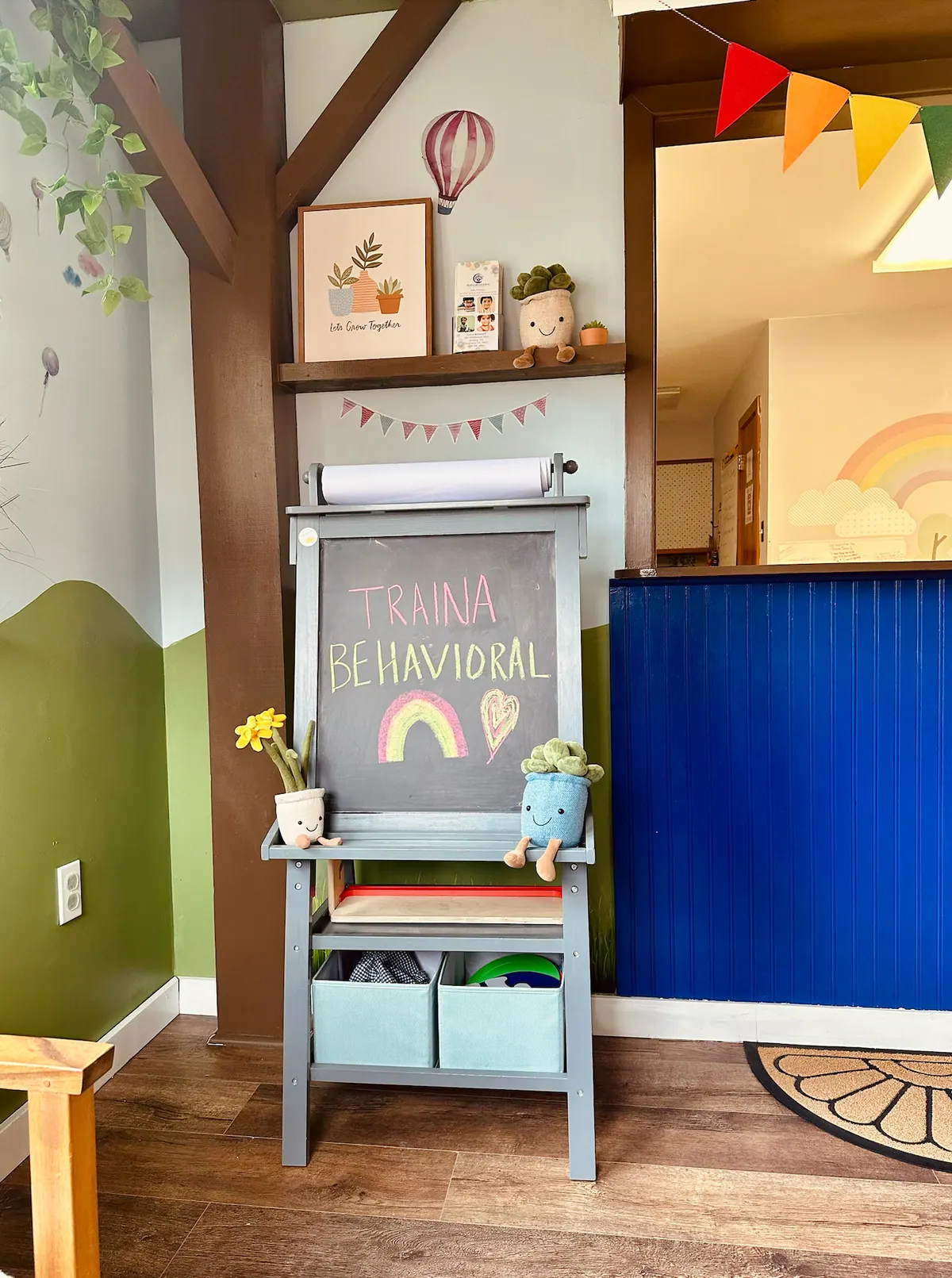
Centers can also create opportunities to learn alongside other children. At Traina Behavioral's Langhorne center, individual teaching can be combined with small-group activities that address each child's program goals. Group work may involve play, waiting, communication, shared activities, or moving through a routine with peers.
The center is a separate environment, so the team must plan how new skills will be used elsewhere. Practice at home, school, and in the community can help a child use a skill with different people and materials. See center-based ABA therapy, plus school-based and community-based support options.
A side-by-side comparison
| Question | In-home ABA therapy | Center-based ABA therapy |
|---|---|---|
| Where does teaching happen? | In the child's home and existing routines | In a space arranged for therapy and learning |
| Which goals may be especially well suited to the setting? | Household routines, daily living skills, family interactions, and behavior that occurs at home | Structured teaching, transitions, group activities, and skills practised with peers |
| How can caregivers take part? | Caregivers may observe and practise during real routines | Caregiver coaching can occur in planned meetings, observation periods, or joint sessions |
| How controlled is the environment? | Everyday distractions and family activity remain present | Materials, distractions, and activities can be arranged by the clinical team |
| Are peers usually available? | Usually limited to siblings or planned community activities | Small-group or peer activities may be available |
| What travel is involved? | The therapy team travels to the family | The family travels to the center |
The table describes common differences. Actual programs vary by provider, staffing, treatment plan, and authorization.
In-home ABA
Teaching woven into daily life.
- Goals practised at meals, bedtime, or morning routines
- Skills taught where they need to stick
- Team travels to the family
Center-based ABA
A space built for focused learning and peer practice.
- Predictable routine outside the home
- Materials and structure ready for skill work
- Natural opportunities to practice with peers
Does one setting produce better results?
Research does not support a single answer for every child. A 2017 program evaluation published in Behavior Analysis in Practice found higher learning rates in the center-based portion of one provider's program. The researchers examined existing clinical data, not a randomized trial, and the result cannot tell us which setting will suit a different child or provider. The full study is available through PubMed Central.
Research on naturalistic developmental behavioral interventions also shows why everyday settings can be useful. Teaching within play and naturally occurring activities can support the use of skills beyond a single teaching task. The research review by Schreibman and colleagues describes this naturalistic approach in detail.
These findings point back to individual planning. The Council of Autism Service Providers' practice guidelines give clinicians a framework for assessment, treatment planning, and ongoing review. The setting follows the goals and clinical recommendations developed through that process.
When in-home therapy may fit well
Home-based sessions may be useful when the main goals occur during household routines. Toileting, getting ready, eating, bedtime, and interactions with siblings all depend on the conditions in the home. Working there allows the clinician to observe those conditions directly.
The home can also reduce the adjustment required at the start of services. A familiar space may help a child settle into sessions while the therapist builds rapport. Travel demands on the family are lower, although the household needs enough room and availability for sessions to take place safely.
When a center may fit well
Center-based services can suit children who benefit from a consistent teaching space and access to a wider set of materials. The environment can be arranged around the treatment plan, which helps the team control distractions and create repeated teaching opportunities.
A center may also make peer practice easier to arrange. Social goals should still be specific to the child. Useful goals can include asking to join an activity, communicating a preference, waiting for a brief period, responding to another child's message, or leaving an interaction safely.
Can a child receive therapy in more than one setting?
Some treatment plans include more than one setting. A child might learn a skill in a center, practise it at home, and use it during a community activity. The schedule depends on clinical need, provider capacity, family availability, and insurance authorization.
Teaching across settings requires coordination. The team needs shared goals, clear data, and regular communication so that the child receives consistent support without turning every part of the day into a therapy exercise.
Questions to discuss with the BCBA
- Which goals led you to recommend this setting?
- How will skills be practised with other people and in other places?
- What opportunities will my child have to learn with peers?
- How will caregivers be involved?
- How will you know whether the setting is working well?
- Can the recommendation change as my child's needs change?
A clear answer should connect the setting to the child's assessment. Convenience matters, but it should not be the only reason for a clinical recommendation.
ABA therapy in Langhorne and the surrounding area
Traina Behavioral provides individualized ABA services in the home and at its center in Langhorne, Pennsylvania. Programs are overseen by Board Certified Behavior Analysts and built around the learner's strengths, needs, family routines, and practical goals. You can also review what ABA can help with or what is ABA therapy?
Sources
- Council of Autism Service Providers. ABA practice guidelines for the treatment of autism spectrum disorder.
- Dixon, D. R., Burns, C. O., Granpeesheh, D., Amarasinghe, R., Powell, A., & Linstead, E. (2017). A program evaluation of home and center-based treatment for autism spectrum disorder. Behavior Analysis in Practice, 10, 307–312.
- Schreibman, L., Dawson, G., Stahmer, A. C., and colleagues. (2015). Naturalistic developmental behavioral interventions: empirically validated treatments for autism spectrum disorder. Journal of Autism and Developmental Disorders, 45, 2411–2428.